A free book by Matteo Milani · U.S.O.

DROIDS

How a Team at Lucasfilm Invented the Digital Audio Workstation

Conversations with the Pioneers

In the early 1980s, inside Lucasfilm's Computer Division, a small team of engineers built the Audio Signal Processor and the SoundDroid: a machine that put sound on a screen, as a shape you could see, cut and move. It was the first digital audio workstation. It never went on sale. DROIDS tells how it was made, in the words of the people who made it.

Reserve your free copy
Out on 31 October 2026 Free PDF & ePub Creative Commons (BY-NC-ND)
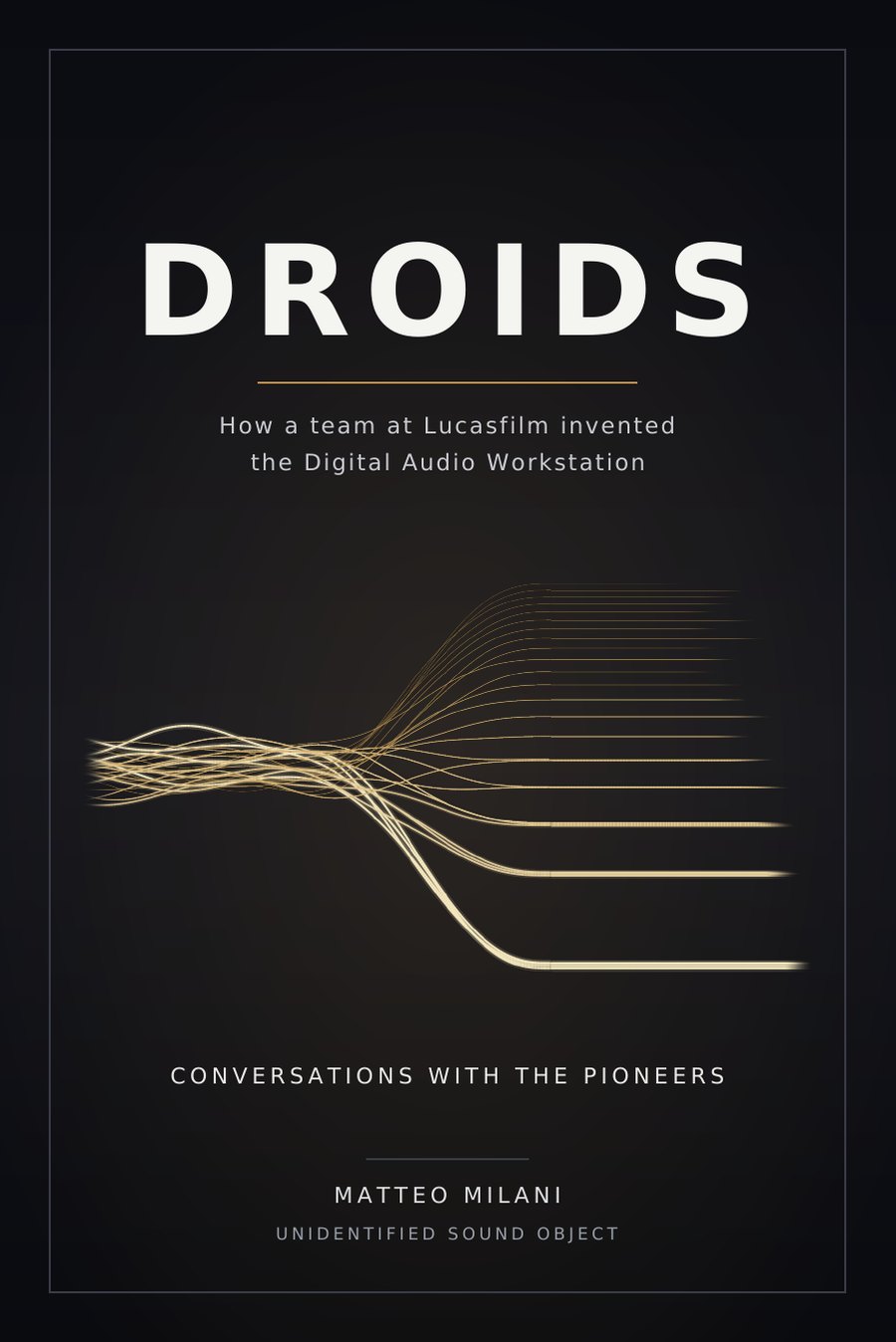
DROIDS: How a Team at Lucasfilm Invented the Digital Audio Workstation, by Matteo Milani (cover)
The story

The machine nobody remembers

Between 1980 and 1985, in a Lucasfilm building in San Rafael, California, a handful of engineers built the first digital audio workstation.

On the SoundDroid's touchscreen, sound became a ribbon you could take hold of, stretch and move through time. Editing was non-destructive, disk-based and programmable, years before those words described everyday tools. The team got the future almost exactly right, and still sold not a single machine.

DROIDS follows the whole arc: how Sprocket Systems came together, how the machine was designed and programmed, how THX and the Deep Note grew up beside it, and how the project wound down while its ideas moved on into Sonic Solutions, Pixar and the wider audio industry.

Years later George Lucas counted it among his landmarks: “I’ve helped move cinema from a chemical-based medium to a digital-based medium.”

Inside the book

See the sound

The SoundDroid’s Electronic Cue Sheet, reconstructed for this book: every track a waveform running top to bottom, time flowing downward past the “now” line, all of it driven from a touchscreen. The industry would later turn this view on its side.
Timeline

Twenty years in nine steps

  1. 1979Lucasfilm sets up its Computer Division; Sprocket Systems grows around Ben Burtt’s sound design.
  2. 1980Lucas starts the digital audio project. James A. Moorer joins and begins designing the ASP.
  3. 1982The ASP prototype runs for the first time.
  4. 1983Moorer composes the THX Deep Note on the ASP.
  5. 1984Lucasfilm and Convergence Corp. form The Droid Works.
  6. 1985The SoundDroid is unveiled at NAB.
  7. 1986The Droid Works winds down; the graphics group becomes Pixar.
  8. 1987Sprocket Systems moves into the Technical Building at Skywalker Ranch.
  9. 1999The sound of The Phantom Menace is built in an all-Pro Tools workflow: the SoundDroid’s way of working is now the industry standard.
The book

Three parts, seventeen chapters

Part I
The Story

How Sprocket Systems came together, how Hollywood learned to edit digitally, and how the SoundDroid, THX and the Deep Note were born side by side.

Chapters 1–7
Part II
How It Was Built

The engineers explain the machine in their own words: architecture, disk scheduling, real-time playlists, debugging and programming the ASP.

Chapters 8–13
Part III
Legacy

The Ranch, how the project wound down, where its ideas went next, and an epilogue on the generation it inspired.

Chapters 14–17

Plus a foreword by Gary Rydstrom, a Who’s Who, timeline, glossary, bibliography and index.

Who's who

Told by the people who were there

Original interviews and first-person chapters written for this book.

Gary Rydstrom
Foreword. Seven-time Academy Award–winning sound designer, who joined Sprocket Systems in 1983
James A. Moorer
Designed the ASP and the SoundDroid; composed THX's Deep Note
Tomlinson Holman
Created THX; coined the term 5.1
M.H. Rubin
Author of Droidmaker; trained Hollywood's first nonlinear editors
The ASP engineering team
John Snell, Curtis Abbott, Bernard Mont-Reynaud, Marie-Dominique Baudot, John Strawn and Jeffrey Barish, each in a chapter of their own
Carla Scaletti
Epilogue. Co-founder of Symbolic Sound, creators of Kyma
“All studios of the future will be built this way.”
James A. Moorer and colleagues, 1986
About the author

Sound designer and composer, Matteo Milani works on sound for film, media and immersive spaces, and has long followed the history of sound and its protagonists.

DROIDS began as a series of interviews for the U.S.O. blog and grew, over many years, into this book: a tribute to the people who changed how the world edits sound.

Free download

Reserve your free copy

DROIDS is out on 31 October 2026, the 41st anniversary of the SoundDroid's presentation at the SMPTE conference in Los Angeles. Leave your details and we will send you the download link on release day.

No newsletter, no spam. This only tells us how many people are discovering these stories.